1. I had used ChatGPT to build a learning app without a software engineering background. The app could display lessons, ask questions and respond to answers. Then I asked it to create a business Japanese course, and I ran into a problem I couldn’t solve by fixing another button: I didn’t know the subject deeply enough to judge what the course should teach.
2. AI could produce a lesson faster than I could read it. But when the material felt wrong, I didn’t always know what to ask for instead. Which teachers should it draw from? What was missing? Was the lesson useful for someone entering a Japanese workplace, or did it just look like a plausible language lesson?
3. A few weeks earlier, I had been so impressed by my own experience learning with ChatGPT that I wanted to turn it into a product. Now I was discovering how much work was hidden inside the word “teach.”
Two daughters, forty minutes and a very patient teacher
4. I have two young daughters, and I keep wondering what learning will look like as they grow up. I want them to develop the confidence to use AI, ask good questions and recognize when an answer deserves more scrutiny. That also made me curious about what AI-assisted learning could offer me.
5. One concern stayed with me: getting better answers is not necessarily the same as learning. A study of nearly 27,000 secondary students in China reported higher homework scores but worse closed-book exam performance after AI adoption, with losses concentrated among students whose behavior suggested they were outsourcing the work. I wanted to explore a use of AI that would make me explain, question and apply what I encountered.
6. I decided to start with myself. I had built businesses in e-commerce and immersive entertainment and was now managing a dental practice in San Francisco. I wanted to sharpen my understanding of how founders recognize opportunities and turn them into businesses.
7. I also had a convenient classroom: my car. I drove roughly twenty minutes to work and twenty minutes home. Those forty minutes were already spoken for, but my attention wasn’t. Founder interviews and company stories seemed like a much better use of that time than another hour I would have to find somewhere else.
8. Around then, I discovered that ChatGPT could run tasks on a schedule. As someone who already used it extensively, I immediately saw a possibility: I could give it standing instructions to prepare a daily learning assignment and check in with me afterward. I could make learning about start-ups part of my routine.
9. Duolingo was already proof that I could maintain a small daily habit. At the time of writing, my streak stands at 1,874 days. I wondered whether I could build something similar around a subject I wanted to use in my own life.
10. I called my ChatGPT project Founder OS.
My commute became a course about companies
11. I asked ChatGPT to find founder interviews, company stories and useful supporting material. Before I listened, it would give me questions to keep in mind. Afterward, I would explain what had happened, apply an idea to a different situation and revisit something from an earlier lesson. ChatGPT would read my answers, challenge my reasoning and help decide what I should study next.
12. I wanted variety: successful companies, spectacular failures, different countries and different ways of making money. I also wanted to understand the beliefs behind the businesses. What did a founder see that other people missed? Why was the conventional view reasonable? How much of the eventual success came from the idea, and how much came from execution, timing or luck?
13. The material pulled me in. Airbnb and DoorDash led me further into Y Combinator’s companies and ideas. WeWork, Nubank, Coupang and other cases opened up very different business models. I found myself following Acquired, hosted by Ben Gilbert and David Rosenthal, and How I Built This with Guy Raz. One story introduced me to another founder, book or way of thinking. My commute started producing things I wanted to discuss after I got out of the car.
14. By September 2, I was enthusiastic enough to write: “Gen AI, if used correctly, is a great tool to enhance knowledge accumulation and brain development instead of stifling learning.” That was a big hypothesis. What excited me was the experience behind it: I could ask more questions, get immediate feedback and connect what I was hearing to something I already understood.
WeWork made me defend my answer
15. In the WeWork case, ChatGPT asked how a company could grow while destroying economic value. I explained it through customer acquisition cost and customer lifetime value, including the cost of building locations in my calculation. ChatGPT challenged that terminology. I pushed back, and the discussion became more precise: what return did each location need to generate on the capital invested in it?
16. Later questions brought me back to the distinction and to what WeWork’s contribution-margin figures left out. My answers became more precise. The exchange had caught a gap, made me work through it and returned to it later.
Shopify brought the lesson into my own business; IKEA and Costco helped me recognize my own interests
17. ChatGPT selected Shopify partly because I had used Shopify to run Giveco. That small piece of context changed the entire assignment. After studying Shopify’s origins, I was asked to examine the operating problems I had encountered myself.
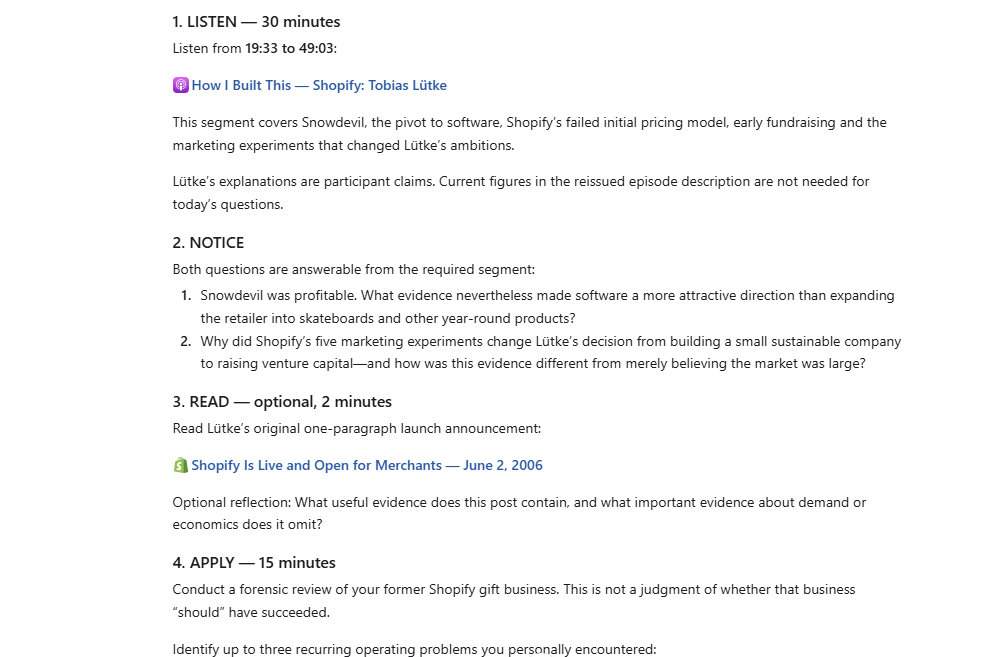
18. I knew those problems well. Inventory tied up cash and warehouse space. Smaller orders could leave thin margins, and increasing advertising spend did not reliably produce proportionally more sales. ChatGPT asked whether those experiences revealed a problem other merchants would pay me to solve—and what evidence I had that they wanted a solution.
19. I had much less evidence for that. The lesson helped me separate operating experience from an assumption about a new market. Its value came from connecting a company’s story to decisions I had actually made, then making me examine my reasoning.
20. IKEA and Costco also helped me recognize a longstanding interest in retail, purchasing and customer value. Exercises made me apply those ideas: when I proposed a temporary store for an invented shelving company, ChatGPT challenged whether counting visitors would tell me enough about the additional sales it generated. I liked having a concrete problem whose answer was not obvious.
I wanted to turn the experience into something other people could use
21. Duolingo came up in our discussions too. Its use of AI in language learning interested me, but so did the product around the learning: short sessions, feedback, visible progress and a reason to come back. I began wondering whether I could combine that kind of structure with the personalized experience I was getting from Founder OS.
22. That became Steps. I wanted to build an app that could help someone identify a learning goal, find worthwhile teaching, work through it and build on what they had learned.
23. Some friends had mentioned wanting to learn about investing and financial markets. I had studied those subjects in college, so I could contribute a framework. I could identify concepts I thought a beginner needed, notice omissions and suggest investors and different schools of thought worth exploring. ChatGPT helped me turn that into a curriculum.
24. The UI/UX was surprisingly easy to build. As a nontechnical founder with no software engineering background, I was vibe coding my way through lesson screens, learner responses and the flow between them. A usable interface took shape quickly, with Steps hosted on ChatGPT Sites.
25. The relational database and the data workflow were harder, but still manageable despite my limited knowledge of relational databases. I had to think about how the app would store user-generated context and progress, remember a learner’s objective, use previous answers and decide what happened next. After several rounds of revisions, I had a working beta with a functioning teaching-and-checking flow—around 15 hours of work spread over several days. For someone with my background, that alone was remarkable.
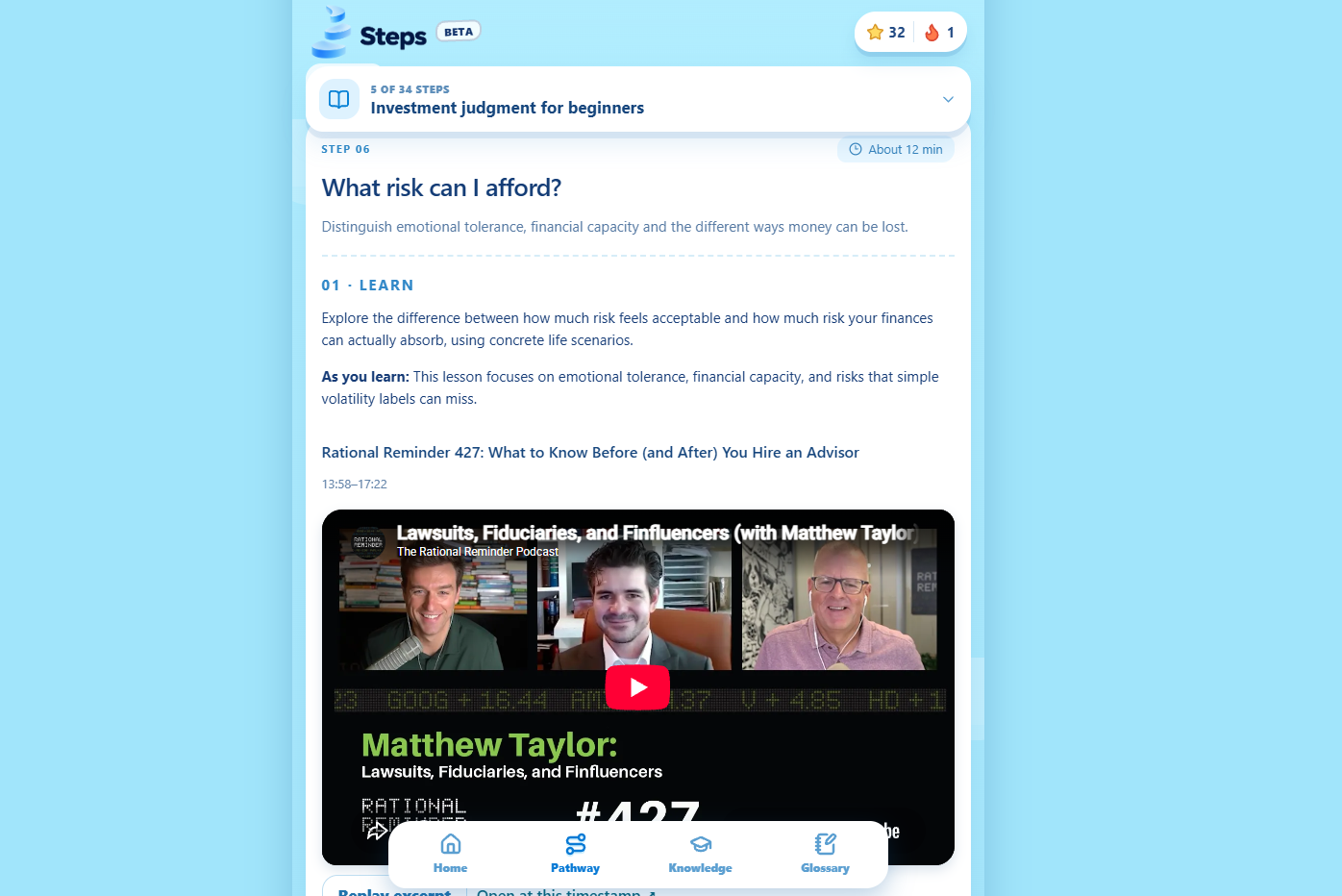
26. But my real experiment was more ambitious than presenting a curriculum I had already helped design. I wanted a person to say what they hoped to learn and have Steps help build the path. The curriculum generator was the part that would test that promise.
Then I tried a subject I couldn’t design myself
27. A friend wanted to learn business Japanese. The request sounded perfectly reasonable: take the Japanese they already knew and help them use it in a workplace. The course needed relevant language, appropriate difficulty and situations they might actually encounter.
28. I expected AI to be good at this. It could search widely, compare sources and generate a structure. But a source mentioning business Japanese was not necessarily a good lesson. The material also had to fit the learner, work within a short session and be interesting enough to keep someone engaged.
29. My attempts to enforce quality sometimes made the experience worse. I added requirements, and the app rejected material that failed them. Then it stopped with an error. I had asked for a better course and ended up troubleshooting a gate that would not open. Some attempts used up their available processing budget before producing anything useful.
30. At other times, AI filled the gap by writing the teaching itself. The lesson could look complete, but I had no dependable way to judge it. It also suggested textbook material that felt too dry for the experience I wanted. The issue was not that textbooks or AI explanations could never be useful. I could use both more confidently in investing, where I understood the territory.
31. Business Japanese exposed how much I had been contributing without noticing. In business and financial markets, I could point to a missing concept or a better teacher. Here, I didn’t know who the good teachers were. I couldn’t tell whether a course covered the right ground. When I asked the AI to improve it, I struggled to explain what “better” meant.
32. That was the uncomfortable part. A beginner often knows the outcome they want but cannot describe the knowledge they lack. They need someone to help them discover the shape of the subject. Founder OS had benefited from my experience, my interests and the considerable context ChatGPT already had about me. My app could not assume every learner arrived with those advantages.
33. I started to feel that AI’s curriculum design depended heavily on the person guiding it. My WeWork case in Founder OS had shown that ChatGPT could correct me. Designing a whole learning path in an unfamiliar field turned out to be a much harder problem than correcting one answer.
Then I stopped doing my own homework
34. While I was building an app to help people learn, my own learning routine started coming apart. I run a dental practice full time. After covering two consecutive shifts at the front desk, I still had my usual work, deadlines and several AI projects waiting for me. My Founder OS assignment was one more demand on my attention.
35. I kept listening to podcasts in the car and looking for more episodes. But I stopped doing much of the written Q&A. The stories still interested me; a full set of exercises after each one had become harder to justify against everything else I wanted or needed to do.
36. I had seen something similar with Japanese. When I needed it for work with Japanese IP licensors, I attended a weekly class. When that need disappeared, I stopped. Duolingo remained as a small daily habit. What I was willing to sustain depended on both the effort required and my reason for learning.
37. Founder OS already had instructions for lighter days and avoiding backlog, but they did not consistently produce a manageable experience. For Steps, that meant making the smallest useful action clear, allowing deeper sessions when someone wanted them and making it easy to return after a missed day.
What building Steps taught me about expertise
38. Looking back, I had been contributing more to Founder OS than I realized. My business experience helped me ask follow-up questions, recognize a useful example and push back when an explanation did not fit. ChatGPT could challenge me in return. That exchange worked partly because I had enough knowledge to participate in evaluating it.
39. Business Japanese exposed the limits of that arrangement. I could describe the learner’s goal and build the screens, but I could not confidently judge the curriculum’s sequence, difficulty or workplace relevance. Improving the interface would not resolve those questions. I needed people with the expertise to assess the course and explain what should change.
40. This is where human expertise matters most in my experiment: defining what good looks like, identifying omissions and evaluating whether a learner is making progress. AI gave me considerable help with research, explanations, exercises and prototyping. The speed of that work made a dependable way to judge its quality more important.
41. For Steps, the next test needs to go beyond whether the app runs and the lessons look convincing. I want a subject expert to review a narrowly defined course, then see whether learners can use what they have studied in a new situation without the app supplying the answer. I also need to learn whether those sessions feel worthwhile enough for people to return. My own abandoned homework is a reminder that learning quality and sustained participation both need attention.
42. I began by asking ChatGPT to help me become more capable of building a business. It helped me find a problem I cared about and build something concrete around it. Now I have to bring the same scrutiny to my product that I wanted from my AI teacher: what can the learner do afterward, and what evidence would convince me that it helped?
Podcast episodes to explore
Airbnb — Masters of Scale Do things that don’t scale — Brian Chesky. Hosted by Reid Hoffman.
DoorDash — Crucible Moments The “Wrong” Moves That Built a Giant — Tony Xu. Hosted by Roelof Botha.
Nubank — Founder’s Field Guide David Vélez — Building the Branchless Bank. Hosted by Patrick O’Shaughnessy.
WeWork — How I Built This HIBT Lab! WeWork: Miguel McKelvey. Hosted by Guy Raz.
Coupang — The Synopsis Coupang: Building the Leading South Korean Ecommerce Business from the Ashes of Mediocrity. From Speedwell Research.
Shopify — How I Built This Shopify: Tobias Lütke. Hosted by Guy Raz.
Costco — Business Breakdowns Costco: Relentless Focus on the One Thing. With Patrick O’Shaughnessy, Zack Fuss and Chris Bloomstran.
IKEA — Acquired IKEA. Hosted by Ben Gilbert and David Rosenthal.
Duolingo — The Tim Ferriss Show Episode #607 — Luis von Ahn. Hosted by Tim Ferriss.